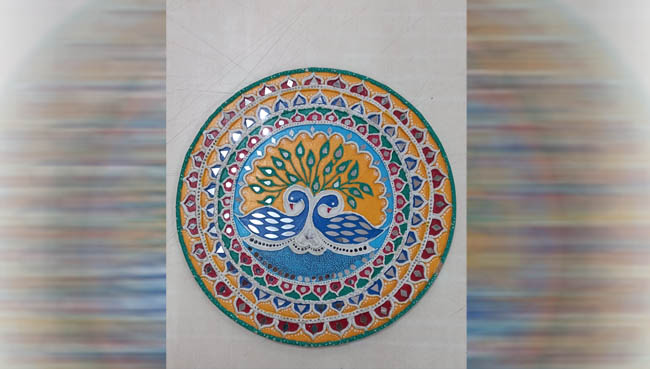
Lippan Art – A traditional Mural craft By Vedi Rangani - class VII
Lippan Art is a traditional craft from the Kutch region of Gujarat, India. It involves
creating intricate mud and mirror work on walls. Primarily in the interiors of Bhungas
(Mud huts) This art form’s origin are deeply rooted in the rural communities of Kutch
with the Rabari , Kumbhaar , Marwada , Harijan and Mutwa communities developing
the craft over generations. Lippan itself refers “to apply” referring to the mixture of
clay and camel dung or wild ass dung as a base for the murals.
Key facts
Origin: Kutch region, Gujarat, India.
Materials: Clay, dye colour, mirrors.
Purpose: Initially used for decorating the interiors of Bhungas, the mud huts of the
local communities.
Motifs: Designs often include geometric patterns, animals, birds, and scenes
inspired by nature.
Significance: Not only a decorative art form but also reflects the lifestyle, culture,
and environment of the artisans.
Tradition: Passed down through generations, particularly by women from the
Rabari, Harijan, and Meghwal communities.
Evolution: Over time, the craft evolved to incorporate vibrant colors and various
designs beyond the traditional white-painted mirrors.
Symbolism: Mirrors are believed to have aesthetic and practical purposes, such as
making homes appear larger and warding off evil spirits.